This article was written on 19-01-2025.
Author’s note: Some of the concepts in this article are from the book “The Divided Self” by R.D. Laing and one may refer to the book for a better understanding of those concepts.
What makes us human? At first glance, this might seem like a simple question - we have bodies, minds, feelings, and thoughts. But as we dive deeper into this exploration, we discover layers of complexity that reveal the nature of human existence. This journey will take us from our physical reality through our emotional and mental experiences, ultimately leading us to confront the mysterious nature of consciousness itself. Along the way, we'll discover how different ways of seeing the same reality can reveal profound truths about who and what we really are.
What are humans? We have a physical body that consists of cells, tissues, various organs, a nervous system, and many other things that make us capable of carrying out certain processes of a "living being," such as growth, reproduction, response to stimuli, etc. But even plants have that, we don't call them humans.
Imagine you are having a conversation with your friend, he is saying something and you are listening. You know and can see him as another "person" just like yourself without you changing or doing anything differently. While we could view him as an intricate system of chemical processes and biological reactions, that's not how we naturally perceive him in conversation.
These two perspectives of seeing someone as a person versus seeing them as an organism represent different "intentional acts." One acts towards an organism differently from the way one acts towards a person.
For example, if one is listening to another person talking, one may either: Be studying or focusing on verbal behaviour in terms of neural processes, how their speech works and the physical process of speaking, or Be trying to understand what the other person is saying.
In the latter case, an explanation of his speech, and verbal behaviour in terms of the general physical and biological processes that must necessarily be going on of his verbalization is not of any use to a possible understanding of what that person is saying.
Conversely, an understanding of what the person is saying is not of any use to understanding how his brain cells are metabolizing oxygen and running other processes to result in verbal behaviour. That is, an understanding of what he is saying is no substitute for an explanation of the relevant biological or organismic processes, and vice versa.
Man as seen as an organism or man as seen as a person discloses different aspects of human reality. If the other is seen as a "person" he will be responsible, capable of choice, in short, as a self-acting agent. Seen as an organism, all that goes on in that organism can be conceptualized at any level of complexity – atomic, molecular, cellular, systemic, or organismic. Whereas behaviour seen as personal is seen in terms of that person's experience and his intentions, behaviour seen biologically or organismically can only be seen as the contraction or relaxation of certain muscles, etc. In man seen as an organism, therefore, there is no place for his desires, fears, hope or despair as such.
Let's understand this with the help of this example:
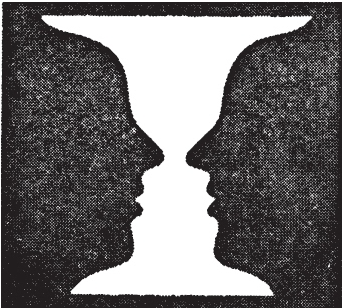
In this figure, there is one thing on the paper which can be seen as a vase or as two faces turned towards each other. There are not two things on the paper: there is one thing there, but, depending on how it strikes us, we can see two different objects. The relation of the parts to the whole in one object(say vase) is quite different from the relation of the parts to the whole in the other object(say faces).
If we describe one of the faces seen we would describe, from top to bottom, a forehead, a nose, an upper lip, a mouth, a chin, and a neck. Although we have described the same line, which, if seen differently, can be the one side of a vase, we have not described the side of a vase but the outline of a face.
Just as the vase-faces image shows us how one reality can be perceived in two distinct ways, our understanding of human nature also requires us to hold multiple perspectives simultaneously. Through this analogy, we can begin to map out the different levels of human existence that make us who we are. Let's examine these distinct but interconnected aspects of our nature.
Now, even the same thing, seen from different points of view, gives rise to two entirely different descriptions, and the descriptions give rise to two entirely different theories, and the theories result in two entirely different sets of action. The initial way we see a thing determines all our subsequent dealings with it.
Now that we have figured that we are not "just an organism" but something more than that, we are capable of having a choice, we are responsible, and we go through the experiences of "our self" and also the world, we experience emotions such as love, fear, despair, etc.
So far we have made two distinctions:
- Humans as biological organisms (cells, tissues, processes)
- Humans as beings with emotions, thoughts, and experiences
Now, let's get into the last and final one. Do you know or remember how you can be aware of your thoughts and emotions themselves? When you are sad, you are not just experiencing sadness, you can be aware that you are sad, for example, you go to your friends and say that you are sad.
There are three layers to this:
- The emotion of sadness
- The person experiencing the emotion of sadness
- The awareness of the person experiencing the emotion of sadness. Your ability to observe these thoughts and feelings as if from a distance or as a third person, to question them, to recognize them as temporary states rather than your entire being. This is Consciousness operating at layer three.
Consciousness is not just another layer added on top of our physical and mental existence - it's what allows us to be aware of all these layers in the first place. Think about how you can be angry, and simultaneously know that you're angry, and even question whether your anger is justified.
This self-reflective awareness enables us to transcend both our physical and mental experiences. It's what allows us to choose how we respond to our emotions rather than being controlled by them. It's what enables us to shift between seeing ourselves and others as organisms or as persons, as we discussed earlier. Without consciousness, we couldn't make these perspective shifts - we'd be locked into a single way of experiencing reality.
We've seen how humans can be viewed as biological organisms and as conscious beings with emotions and thoughts. But who is doing this viewing? Who is able to switch between these perspectives? When we realize we can observe our own thoughts and feelings as if from a distance, we encounter a profound mystery: the observer cannot be the same as what is being observed. Just as we saw earlier that a person cannot be reduced to merely an organism, we now find that consciousness cannot be reduced to merely thoughts and feelings.
But then what is Consciousness? Who am I who is watching myself go through a certain experience?
Who am I? My name is not me, it's my name. My work is not me, it's my work. My behaviour is not me, it's my behaviour. I am not the body, it's my body, I am not the mind, it's my mind. I can go on and on but the question remains the same.
So who am I? I am not just my body, though I have one. I am not just my thoughts and feelings, though I experience them. The question 'Who am I?' might not have a final answer, but the very ability to ask it - and to recognize its profound implications - is itself a defining feature of human nature.
Author's Note: As a student without formal training in psychology or philosophy, this article represents my interpretation of concepts from R.D. Laing's book "The Divided Self." While I've attempted to understand and present these ideas faithfully, my interpretation may differ from Laing's original meaning. This piece reflects my journey of understanding human nature, but I encourage readers to approach it just as an exploration and to refer to Laing's original work for a more accurate understanding of these concepts.